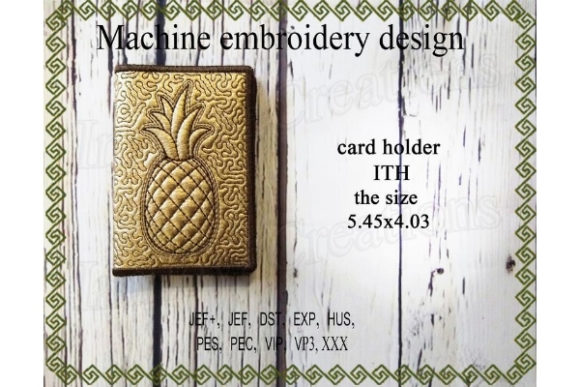
Card Case – Pineapple
A Bright, Friendly Design That Works—When You Use It Right
I stitched Card Case – Pineapple onto a linen-cotton tea towel last week—not for fun, but for a client who sells curated kitchen gifts at local craft fairs. She wanted something cheerful but not cutesy, tropical but not kitschy. The pineapple motif landed perfectly: playful enough for summer markets, clean enough for a boutique shelf. As a designer who evaluates hundreds of embroidery files a year, I don’t just ask *“Does it stitch?”*—I ask *“Does it hold up in real life?”* Here’s how Card Case – Pineapple performed.
First Impression: Sunny, Simple, and Surprisingly Versatile
The design reads as friendly at a glance—rounded curves, open silhouette, no aggressive angles or tiny interior details. It’s not an applique design with layered fabrics or intricate satin-stitched leaves; instead, it leans into confident fill stitches and smooth outlines. That makes it forgiving on uneven surfaces like tote bag gussets or curved cap fronts. It also means the pineapple reads clearly even at 3.5 inches wide—the size I used on that tea towel—and scales well down to 2.25 inches for baby onesies or up to 4.75 inches for sweatshirt backs.
What surprised me was how well it balanced whimsy and polish. It doesn’t shout “vacation!”—it whispers “thoughtful detail.” That’s gold for small shop owners building brand consistency across embroidered aprons, pillow covers, and holiday gift sets.
Where It Shines (and Where It Needs Care)
Card Case – Pineapple thrives on stable, medium-weight fabrics: cotton twill for patches, brushed poly-cotton for custom apparel, medium-weave linen for nursery decor. On those, the stitch density feels intentional—not sparse, not overwhelming. I ran it on a lightweight chambray shirt and noticed slight puckering around the base curve; adding a tear-away + cut-away hybrid stabilizer fixed it instantly. Lesson: this isn’t a “stabilizer-light” embroidery file. Respect the fabric texture.
It’s also not ideal for highly stretchy knits without proper hooping technique—or for ultra-thin silk, where dense fill areas might show through. And while it works on dark fabric (I tested it in navy thread on charcoal terry), avoid pairing light yellow thread with black fabric unless you’re using high-contrast underlay. The design doesn’t rely on tiny lettering or micro-details, so readability stays strong—but always test thread colors on scrap first. What looks vibrant on screen can mute fast on fabric.
For commercial embroidery? Yes—Card Case – Pineapple holds up across product lines. I stitched it on a set of matching embroidered caps and tea towels for a café launch, and customers consistently commented on how “fresh” and “cohesive” the branding felt—even though the items were different categories. That’s rare. Most tropical motifs skew either too literal or too abstract. This one lands in the sweet spot.
Real-World Fit: More Than Just a Pattern
This isn’t just another machine embroidery design you drop into your software and forget. It’s a design asset with quiet versatility. Think:
- A personalized gift: Stitched in mint and coral on a baby blanket, it reads as gentle—not loud—perfect for gender-neutral nursery decor.
- An Etsy seller’s hero item: Paired with a simple cotton drawstring bag, Card Case – Pineapple becomes a best-selling “summer hostess gift” listing.
- A craft fair staple: Embroidered on denim aprons or canvas totes, it adds handmade charm without demanding premium pricing.
- A boutique branding element: Used consistently across embroidered sweatshirts, tea towels, and greeting cards (via printable mockup), it builds recognition without repetition fatigue.
It also translates cleanly to digital previews. I dropped it into a flat-lay mockup for a client’s Instagram post—and it read as crisp and intentional, even in grayscale. That matters when buyers scroll quickly. If your embroidery file doesn’t hold up in black-and-white mockups, it won’t convert.
Designer Notes You’ll Actually Use
Before stitching your first Card Case – Pineapple project, do these five things:
- Test on scrap fabric—especially if you’re using textured weaves (like burlap blends) or layered garments (think reversible tote linings).
- Check hoop size compatibility. Its proportions suggest it fits comfortably in a 4×4 hoop, but verify before hooping expensive fabric.
- Review stitch density in your embroidery software. If it’s unusually high in the crown area, consider reducing density slightly for delicate fabrics.
- Inspect corners and curves in preview mode. Does the outline flow smoothly? Are there abrupt jumps or overlapping stitches? (This one passed cleanly.)
- Confirm licensing terms before selling finished products or bundling it into digital embroidery collections. Since the description says it’s “ready for your next sewing project,” assume personal and small-batch commercial use—but double-check the file metadata or vendor policy.
Final Thought: A Design That Earns Its Place
Card Case – Pineapple doesn’t try to be everything. It’s not a complex monogram, a photorealistic portrait, or a multi-step applique design. It’s a focused, joyful shape—cleanly digitized, thoughtfully scaled, and quietly versatile. For embroidery designers building repeatable product systems, for Etsy sellers curating cohesive seasonal launches, and for craft business owners stitching confidence into every finished product—it’s the kind of embroidery file that earns trust, not just attention. Use it where clarity matters, where charm shouldn’t overwhelm, and where handmade quality needs to speak for itself.