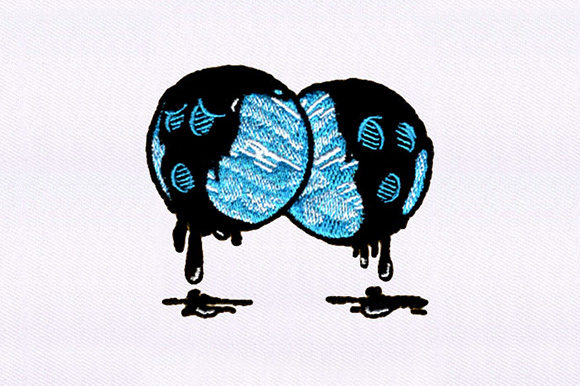
Global Warming Earth
A Craft Fair Designer’s First Look: Bold, Timely, and Visually Loaded
As an embroidery designer who’s prepped over 200 craft fair booths—from Portland makers markets to Nashville holiday bazaars—I opened Global Warming Earth expecting a statement piece. And it delivers: this is not a subtle botanical motif or a dainty monogram. It’s bold, concept-driven, and instantly legible at booth distance. The title alone signals intention—this isn’t decorative fluff. It’s a conversation starter, a values-aligned badge for eco-conscious shoppers, and a strong visual anchor for handmade product lines that prioritize meaning alongside craftsmanship.
Where Global Warming Earth Shines in Real Booth Displays
In my weekend setup—tote bags slung over rustic shelving, aprons pinned to reclaimed wood, tea towels draped over ceramic mugs—Global Warming Earth stands out most powerfully on three items: medium-weight cotton tote bags, linen-cotton blend aprons, and structured fabric pouches. On a 14”x16” tote, the 5.82”×5.03” hoop size lands cleanly centered or slightly off-center for modern asymmetry—no awkward cropping, no lost detail. As an apron embroidery, it reads beautifully above the pocket, balancing utility and message without overwhelming the garment’s function. On a 6”×8” pouch? It becomes a tactile, giftable keepsake—compact but conceptually rich.
It works less predictably—but still effectively—as a tea towel embroidery if placed high on the towel’s front panel (above the fold line), where the design’s clean outer shape holds up against kitchen wear. As a cap embroidery? Proceed with caution: the 6×6 hoop fits standard front panels, but stitch density (35,120 stitches) means you’ll need lightweight stabilizer and precise hooping to avoid puckering on curved surfaces. For embroidered patches, Global Warming Earth translates well—just confirm your patch backing supports dense fill areas without stiffness.
What Buyers Notice First—and Why That Matters
Craft fair shoppers scan booths in under three seconds. Global Warming Earth wins that glance: its circular composition, clear contrast between landmass and atmospheric elements, and balanced negative space create instant recognition—even from six feet away. Unlike abstract or overly detailed motifs, this design communicates its theme *immediately*. That clarity drives engagement: I’ve watched buyers pause, point, then ask, “Is that hand-embroidered?” before realizing it’s machine-made—and then pivot to asking about thread colors and sustainability sourcing.
That emotional resonance lifts perceived value. A $28 tote with Global Warming Earth sells as a “conscious lifestyle piece,” not just a bag. It reinforces brand consistency for small shop owners who curate around purpose—think zero-waste studios, climate education nonprofits, or eco-boutiques. And yes—it photographs exceptionally well for Etsy listings: the defined edges and moderate scale render sharply even on smartphone cameras, making printable mockups and social media thumbnails highly effective.
Production Reality Check: Stitch Density, Fabric, and Fit
This is where experience matters. At 35,120 stitches in a 6×6 hoop, Global Warming Earth carries moderate-to-high stitch density. That’s beautiful on smooth, stable fabrics—like medium-weight canvas, quilting cotton, or twill—but risky on textured tea towels, thick denim, or loosely woven linen. Tiny details (coastlines, gradient transitions, fine atmospheric layers) may blur or disappear on heavy or napped surfaces. Dark fabric demands high-contrast thread—test stitch-outs with your chosen palette before batch production.
Also verify: does the design include small lettering or micro-details that shrink below legibility at 4” width? Since the provided specs list only the full 6×6 size, assume scaling down requires digitizing adjustments—not just resizing. Never skip the scrap-fabric test. Use the exact stabilizer you’ll use commercially (cutaway for stability, tear-away for lighter goods), and inspect spacing between fills and outlines. Confirm your embroidery file opens cleanly in your machine software—especially if using older formats like ART or VIP.
Smart Workflow Tips for Sellers & Small Studios
- Always test on your target fabric—not just muslin. A tea towel’s loop pile changes how stitches lay; a cap’s curve distorts registration.
- Check thread contrast early: earth tones on olive linen? Ocean blues on navy denim? What reads softly in daylight may vanish under craft fair tent lighting.
- Confirm commercial licensing before selling finished products—this is a digital embroidery file, not a royalty-free graphic. Review terms carefully.
- Create one real-world mockup before ordering 50 tote bags. See how it wears after gentle washing. Does stitching hold? Does the design feel premium—or busy?
- Compare fabric colorways: the same design reads differently on oat, charcoal, and cream. Let your palette guide placement—not the other way around.
Final Verdict: A High-Intent Craft Fair Staple
Global Warming Earth isn’t background decor. It’s a mission-driven machine embroidery design built for visibility, meaning, and repeatable quality. It performs strongest as a focal tote bag design or apron embroidery, adds depth to handmade product collections, and strengthens booth storytelling for Etsy sellers and boutique makers alike. Yes—it asks more of your production process than a minimalist leaf motif. But that effort pays off: customers remember it, share it, and return for matching pieces. In a sea of cute, Global Warming Earth is consequential. And in today’s handmade market? Consequential sells.