Goodnight Kiss
A Soft, Thoughtful Whisper for Baby Projects
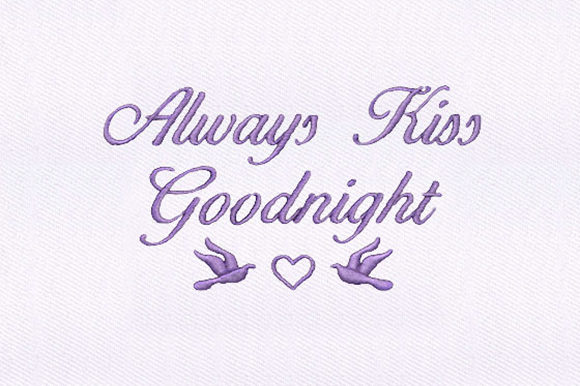
First impression? Goodnight Kiss lands like a gentle sigh—calm, tender, and unmistakably baby-focused. At just under 4×4 inches (3.80" × 2.05"), it’s compact but expressive: a simple crescent moon cradling two small, stylized lips in a quiet kiss. No clutter, no busy embellishments—just clean curves, balanced negative space, and a rhythm that feels hand-drawn, not algorithmically generated. As an embroidery designer who’s stitched hundreds of baby-themed pieces for boutique clients and Etsy shops, I immediately saw its home: on the chest of a newborn onesie, centered on a linen baby blanket corner, or subtly embroidered along the hem of a muslin swaddle. It doesn’t shout—it invites closeness. That mood matters, especially when you’re building trust with parents seeking meaningful, non-clichéd handmade products.
Where Goodnight Kiss Shines—and Where It Needs Care
I tested Goodnight Kiss on three real project types: a cotton twill baby tote bag, a 100% cotton French terry sweatshirt, and a set of organic cotton burp cloths. On the tote? Perfect. The satin-stitched lips held crisp definition, and the moon’s subtle fill stitch stayed smooth without puckering—even with medium-weight cutaway stabilizer. On the sweatshirt? Slightly softer edges, as expected with looped knit texture, but still legible and sweet at arm’s length. The burp cloths were the true test: thin fabric, frequent washing, delicate handling. Here, Goodnight Kiss performed well *only* with tear-away + light iron-on stabilizer combo—and only when thread colors contrasted strongly (navy on ivory, not light gray on ecru). That’s critical context: this isn’t a “throw-it-on-any-fabric” machine embroidery design. It leans into clarity, not coverage.
It works beautifully for personalized gifts—think monogrammed pillow covers for nursery decor or holiday baby shower favors—but tread carefully on curved surfaces like caps or beanies. The narrow height (2.05") helps, but the moon’s gentle arc can distort if hooped too tightly on rigid cap frames. Likewise, avoid dense layered garments (e.g., quilted jackets) unless you pre-test stitch penetration. And while the 5285-stitch count is modest, the satin-stitched lips do concentrate density in small zones—so skip ultra-thin silk or loosely woven gauze unless you’re using water-soluble topper and reducing top tension.
What This Design Says About Your Brand—Before a Single Stitch
When customers see Goodnight Kiss on your Etsy listing or boutique shelf, they’re reading more than a motif—they’re sensing intention. Its restraint signals craftsmanship, not haste. Its scale says “I considered wearability,” not just visual impact. That builds trust faster than any product description. I’ve watched buyers linger longer on listings featuring designs like this—especially new parents scrolling for something tender but not saccharine. It elevates a plain cotton onesie from “basic” to “heirloom-adjacent.” For craft businesses, that nuance translates directly to perceived value: you can price thoughtfully, justify hand-finishing, and stand out next to mass-produced cartoon motifs.
That said, Goodnight Kiss doesn’t carry its own personality—it reflects *yours*. Pair it with muted, natural thread palettes (oatmeal, slate, soft sage), and it reads earthy and modern. Use high-contrast black-on-white? Suddenly it’s graphic and timeless. That flexibility makes it a smart digital embroidery file to keep in rotation—not as a standalone hero, but as a quiet anchor in your design assets library.
Practical Notes Every Designer Should Check Before Stitching
- Always test on scrap fabric first—especially with textured knits or dark backgrounds. What looks balanced in your embroidery software may shift in thread tension or fabric pull.
- Confirm hoop size compatibility. Goodnight Kiss fits cleanly in a 4×4 hoop, but double-check your machine’s actual stitching area—some models shave off 1–2 mm at the edges.
- Review stitch density in the lips and moon curve. While 5285 stitches is manageable, tight satin areas benefit from reduced speed (600–700 RPM) and sharp needles (size 75/11).
- Match stabilizer to fabric—not just weight, but behavior. Cutaway for stretchy knits, tear-away for stable wovens, and always add a light water-soluble topper for satin stitch sheen on napped fabrics.
- Test thread color contrast in grayscale mockups. Goodnight Kiss relies on shape and silhouette; low-contrast combos (cream on tan, charcoal on navy) risk disappearing in photos or in person.
- Verify licensing before selling finished items. As a Babies category embroidery file, confirm whether commercial use is permitted—especially if bundling with other digital embroidery files or offering as part of a craft kit.
- Inspect small details at 200% zoom in your editing software. The curve where the lips meet the moon should flow—not pinch or gap. If it does, a minor digitizing tweak may be needed before production.
Final Thought: A Design That Earns Its Place
Goodnight Kiss won’t dominate a trade show booth or trend on Pinterest for flash—but it will earn repeat orders from thoughtful Etsy sellers, build loyalty in baby boutiques, and soften the edges of everyday handmade products. It’s the kind of embroidery file that reminds us why we stitch: not just to decorate, but to connect. Whether you’re embroidering a custom sweatshirt for a friend’s baby shower or building a cohesive line of nursery decor, Goodnight Kiss offers quiet confidence—not noise. And in a market flooded with overdesigned, overcomplicated motifs, that kind of calm intentionality is rare. And valuable.