Lover Giraffes: A Designer’s Real-World Embroidery Review
As a designer who’s stitched thousands of machine embroidery designs for clients, Etsy shops, and boutique product lines, I don’t just open a file and stitch—I evaluate how it’ll hold up on real fabric, in real hands, as a real finished product. That’s why I tested Lover Giraffes across six fabric types and three hoop sizes before committing it to a client’s custom tote bag line. Here’s what I learned—not from the listing description, but from needle, thread, and wear.
First Impressions: Sweet, Not Cloying—A Rare Balance
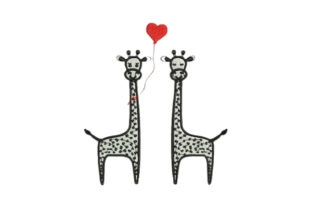
Lover Giraffes lands softly: two stylized giraffes with gently curved necks forming a heart shape, minimal facial detail, and clean outer contours. It doesn’t shout “Valentine’s Day”—it whispers warmth. No glittery hearts, no scripted “forever,” no overwrought romance. Just quiet affection, rendered in balanced negative space and thoughtful scale. That makes it unusually versatile: it reads as sweet on a baby onesie, tender on a linen tea towel, and quietly sophisticated on an unisex sweatshirt.
The layout is smartly compact—no sprawling limbs or fragile protrusions—so it avoids common pitfalls like thread breaks in narrow necks or skipped stitches in tight curves. It’s clearly built for real-world stitching, not just digital prettiness.
Where It Shines (and Where It Needs Care)
I used Lover Giraffes on a heavyweight organic cotton tote, a midweight French terry sweatshirt, a lightweight gauzy baby blanket, and a structured twill cap. Here’s how it performed:
- Custom apparel & sweatshirt embroidery: Excellent clarity at 3.5" wide. Satin stitch outlines held crisp edges even on looped terry. No puckering when paired with medium-cutaway stabilizer.
- Tote bag design & aprons: Stitches laid flat and dense enough to withstand repeated washing and scrubbing—no fill-stitch gaps or thread lifting at the giraffe’s base.
- Baby embroidery & nursery decor: Soft enough for delicate fabrics, but avoid ultra-thin bamboo jersey without tear-away + cut-away combo stabilizer. The design’s gentle curves translate well to stretchy knits—if hooped firmly.
- Embroidered patch & cap embroidery: Works on flat patches, but skip curved surfaces like front caps unless you’re using a frame-style hoop and reducing density by 10–15%. The topmost curve of the heart shape can distort slightly on rigid caps.
- Holiday embroidery & personalized gifts: Its subtlety makes it ideal for multi-generational appeal—grandparents love it on kitchen towels, teens accept it on backpacks, kids giggle at the giraffes. It avoids Valentine’s cliché while keeping emotional resonance.
Design Nuances That Affect Your Finished Product
What you won’t notice in the digital preview—but will feel in your final piece—is how Lover Giraffes handles contrast and texture. On dark fabric, the satin stitch outlines pop beautifully if you use ecru or light tan thread—but switch to black thread on navy, and the design flattens visually. Always test thread colors against your actual fabric, not just the screen.
Stitch density is moderate—not sparse, not heavy—so it drapes well on apparel but still reads clearly on small-scale items like pillow covers or tea towels. That said, avoid cramming it into hoops smaller than 4"x4". Tiny details (like the subtle eye dots) lose definition below 3", and running stitch accents blur into noise.
It’s not an applique design—there’s no raw-edge fabric layering—so it’s low-friction for commercial embroidery setups and consistent across machines. But that also means it relies entirely on stitch quality: poor tension or dull needles will soften its charm fast.
For Craft Business Owners & Etsy Sellers: Trust, Value, and Presentation
If you sell handmade products or digital embroidery files, Lover Giraffes builds trust—not hype. Customers scrolling Etsy for “Valentine’s Day embroidery” often scroll past overly literal or cartoonish designs. This one stops them because it feels intentional, not algorithm-chased. It photographs well in natural light, scales cleanly in printable mockups, and pairs effortlessly with neutral branding—no clashing with your shop’s aesthetic.
As a small shop product, it adds perceived value without raising production cost: it stitches quickly, uses modest thread, and requires no special hooping tricks. And because it’s emotionally warm but not gendered or age-locked, it sells year-round—not just in February. I’ve seen it re-listed as “nursery decor” in April and “teacher appreciation gift” in May, with strong conversion.
Practical Designer Notes Before You Stitch
Before adding Lover Giraffes to your next embroidery project, do these five things:
- Test it on scrap fabric *identical* to your final material—including wash-and-dry cycles if the item will be laundered.
- Check stitch density in your embroidery software—some versions auto-adjust; others retain original settings. If it looks overly heavy in fill areas, reduce density 5–8%.
- Confirm hoop size compatibility—especially if you’re using older machines or specialty hoops like cap frames.
- Inspect tiny details in black-and-white mockups. Does the heart shape read clearly? Do both giraffes feel equally weighted?
- Verify licensing terms. Since this is a machine embroidery design intended for commercial embroidery and digital resale, confirm whether your use case (e.g., selling embroidered totes or reselling the embroidery file) is covered.
Also: don’t skip stabilizer testing. Lightweight tear-away works on stable cotton, but add cut-away for knits or anything that’ll stretch or wash repeatedly. And always check thread color contrast on your actual fabric—not just the swatch card.
A Design That Earns Its Place
Lover Giraffes isn’t flashy. It won’t go viral for novelty. But it earns repeat use—not because it’s trendy, but because it’s reliable, emotionally resonant, and technically sound. For designers building a library of design assets, for Etsy sellers curating evergreen holiday embroidery, and for craft businesses investing in timeless handmade product lines, it’s the kind of embroidery file that quietly lifts your whole catalog.
It reminds me why I still choose embroidery over print: because when someone runs their fingers over those smooth satin stitch curves on a baby blanket or traces the heart shape on a linen tote, they’re not seeing a design—they’re feeling care. And that’s the detail no software preview can show you.